
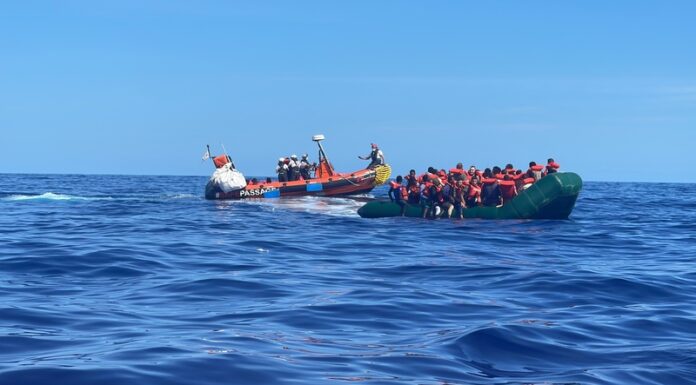
At least 42 people are missing and presumed dead after a migrant boat capsized off the coast of Libya in early November, the International Organization for Migration confirmed on Wednesday, November 12, 2025. Seven survivors were rescued after spending six days stranded at sea following the vessel’s engine failure.
The rubber boat departed Zuwara, a coastal city in northwestern Libya, on November 3, 2025, at dawn. Several hours into the journey, the vessel’s engine failed in high waves, causing the boat to capsize. The craft was carrying 47 men and two women when disaster struck.
Libyan authorities conducted a rescue mission near the al-Buri Oil Field on Saturday, locating the seven survivors who had been stranded without assistance for nearly a week. The survivors endured harsh conditions at sea before their rescue and subsequent transport to Tripoli.
The missing passengers include 29 Sudanese nationals, eight Somalis, three people from Cameroon, and two Nigerian nationals. All 42 individuals are presumed dead following the capsizing, though their bodies have not been recovered.
The International Organization for Migration provided urgent medical care, water, and food to the seven survivors upon their rescue. The survivors were treated for sunburn and skin irritation from prolonged seawater exposure. Medical personnel report that all seven are now in stable condition after receiving treatment in Tripoli.
Libya has served as a main transit point for migrants fleeing war and poverty throughout Africa and the Middle East. The country descended into chaos following a NATO-backed uprising that toppled and killed longtime autocrat Muammar Gaddafi in 2011. Since then, the absence of stable governance has made Libya a hub for human trafficking and dangerous migration attempts.
This incident adds to an already devastating toll in the Central Mediterranean migration route. Reports indicate that more than 1,000 people have died in the Central Mediterranean since the beginning of 2025. Sources vary on specific regional figures, with over 500 deaths reported off the coast of Libya alone during this period, according to the IOM’s Missing Migrants Project.
The November 3 capsizing represents just one of multiple similar incidents in recent weeks. Last month, another migrant wooden boat departed al-Zawiya in northwestern Libya and capsized due to high waves, resulting in 18 deaths. In that incident, 64 people from Sudan, Bangladesh, and Pakistan survived the ordeal.
The pattern of maritime disasters in the Mediterranean reflects the desperation of migrants willing to risk treacherous sea crossings in often unseaworthy vessels. Overcrowded rubber boats with unreliable engines frequently fail in rough seas, leaving passengers stranded far from shore with little hope of rescue.
Migration patterns through Libya have intensified as land routes into the European Union have become more difficult to traverse. Migrants from across sub-Saharan Africa, including Sudan, Somalia, Cameroon and Nigeria, continue to attempt the dangerous Mediterranean crossing despite the well-documented risks.
The IOM’s intervention in providing immediate humanitarian assistance to the survivors demonstrates the organization’s ongoing role in responding to migration crises in the region. The agency’s Missing Migrants Project tracks deaths and disappearances along migration routes worldwide, documenting the human cost of irregular migration.
The nationalities of those missing reflect the diverse origins of migrants attempting to reach Europe through Libya. The 29 Sudanese nationals represent the largest single group among the missing, followed by eight Somalis. The presence of migrants from Cameroon and Nigeria indicates that the Mediterranean route continues to attract people from both East and West Africa.
The confirmation from the United Nations migration agency on Wednesday came more than a week after the boat initially capsized. The delay between the incident and official confirmation reflects the challenges in gathering accurate information about maritime disasters, particularly when so few survivors remain to provide testimony.
As the seven survivors recover in Tripoli, questions remain about the circumstances that led to their boat’s departure and the failure of its engine. The high waves encountered at dawn on November 3 proved catastrophic for the overcrowded rubber vessel, which was ill-equipped to handle rough seas.
The incident underscores the continuing humanitarian crisis in the Mediterranean, where migrants continue to perish in attempts to reach European shores. The rising death toll in 2025 suggests that despite increased awareness of the dangers, desperate individuals continue to attempt the crossing in search of safety and opportunity.