
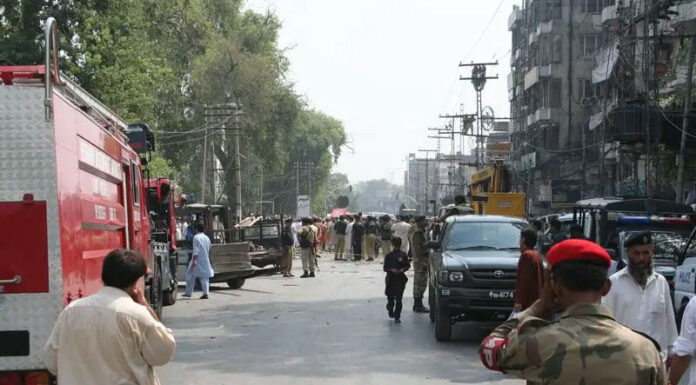
A suicide bombing outside a district court in Islamabad on Tuesday, November 11, 2025, killed 12 people and wounded at least 27 others, marking one of the most significant attacks in Pakistan’s capital in recent years. The explosion occurred at approximately 12:39 p.m. local time near the court entrance, an area typically crowded with hundreds of visitors attending hearings.
Interior Minister Mohsin Naqvi confirmed the attack was carried out by a suicide bomber who targeted a police vehicle stationed outside the court gates. The attacker tried to “enter the court premises but, failing to do so, targeted a police vehicle,” Naqvi told journalists at the scene. The blast was heard for miles across the capital, sending a cloud of smoke into the sky and causing scenes of mayhem as ambulances rushed to transport the badly wounded.
The casualties were mostly passersby and individuals who had arrived for court appointments, according to Islamabad police. The discovery of a severed head near the site, which police said belonged to the attacker, confirmed the nature of the bombing. The bomber was also later spotted in CCTV footage from the location.
Jamaat-ul-Ahrar, a breakaway faction of the Pakistani Taliban, claimed responsibility for the attack. Reports also indicate that the broader Tehrik-e-Taliban Pakistan, or TTP, claimed involvement in the bombing. The TTP is a separate group from but closely allied with the Afghan Taliban, and has been designated as a terrorist organization by both the United States and the United Nations.
Naqvi alleged the attack was “carried out by Indian-backed elements and Afghan Taliban proxies” linked to the Pakistan Taliban, though he noted authorities were “looking into all aspects” of the explosion. The minister’s comments reflected growing tensions between Pakistan and its neighbors over cross-border militancy.
On Friday, November 14, 2025, Pakistani authorities announced a major breakthrough in the investigation with the arrest of four suspects believed to be members of the outlawed TTP. The men were detained in a joint operation conducted by the nation’s Intelligence Bureau and Counter-Terrorism Department.
One of the suspects, Sajid Ullah, is believed to have handled the bomb used in the suicide attack. According to the government, Ullah told investigators that Saeed-ur-Rehman, a TTP commander also known as Daadullah, ordered the attack through the Telegram messaging app. Daadullah sent Ullah photographs of the suicide bomber, an Afghan national who was a resident of Nangarhar province in Afghanistan, with orders to receive him after he crossed the border into Pakistan.
Ullah arranged accommodation for the attacker near Islamabad and later retrieved an explosive suicide vest from a graveyard in the northwestern city of Peshawar on Daadullah’s instructions. He then transported the vest to the capital for use in the attack. The government said Daadullah, originally from Pakistan’s Bajaur region, is part of TTP’s intelligence wing and currently hiding in Afghanistan.
The Islamabad bombing occurred one day after militants attacked a cadet college in Wana on Monday, November 10, 2025. Gunmen stormed the facility in northwestern Pakistan, beginning a gun battle that lasted nearly 20 hours. All the attackers were killed in that assault. Interior Minister Naqvi said Thursday that Afghan nationals were involved in both the Islamabad bombing and the Wana attack.
Defense Minister Khawaja Mohammad Asif said Pakistan is in a state of war and blamed the Afghan Taliban government for the attacks. “We are in a state of war,” Asif stated, warning that Pakistan “has the strength to respond fully.” The attacks underscored Pakistan’s deteriorating security climate as the country faces a resurgence in militancy and increasingly fraught relations with Afghanistan’s government in Kabul.
Prime Minister Shehbaz Sharif condemned both attacks and called for a full investigation, demanding that those responsible be brought to justice. Until Tuesday’s blast, Islamabad was considered safer than the country’s northwest, which has suffered from repeated violence in recent years.
The attacks occurred against the backdrop of failed peace negotiations between Pakistan and Afghanistan. Qatar brokered a ceasefire on October 19, 2025, following deadly cross-border fighting that killed dozens of soldiers, civilians and militants. Since then, two rounds of peace talks had been held in Istanbul, the latest on November 6-7, but the talks ended without agreement after Kabul refused to provide written assurance that the TTP and other militant groups would not use Afghan territory against Pakistan.
Despite the arrests, Prime Minister Sharif offered to undertake talks with Afghanistan’s Taliban-led government in a renewed peace overture while urging Kabul to rein in the TTP. The Pakistani government has accused the Afghan Taliban of harboring TTP fighters, emboldened since the Taliban seized power in Kabul in 2021. Many TTP leaders and fighters are believed to have taken refuge in Afghanistan, though Kabul denies protecting the group.
Pakistan has seen a surge in militant attacks in recent years, with the court bombing representing a significant escalation in violence reaching the previously secure capital. The investigation continues as authorities work to dismantle the network responsible for coordinating the attack and prevent future violence in the region.